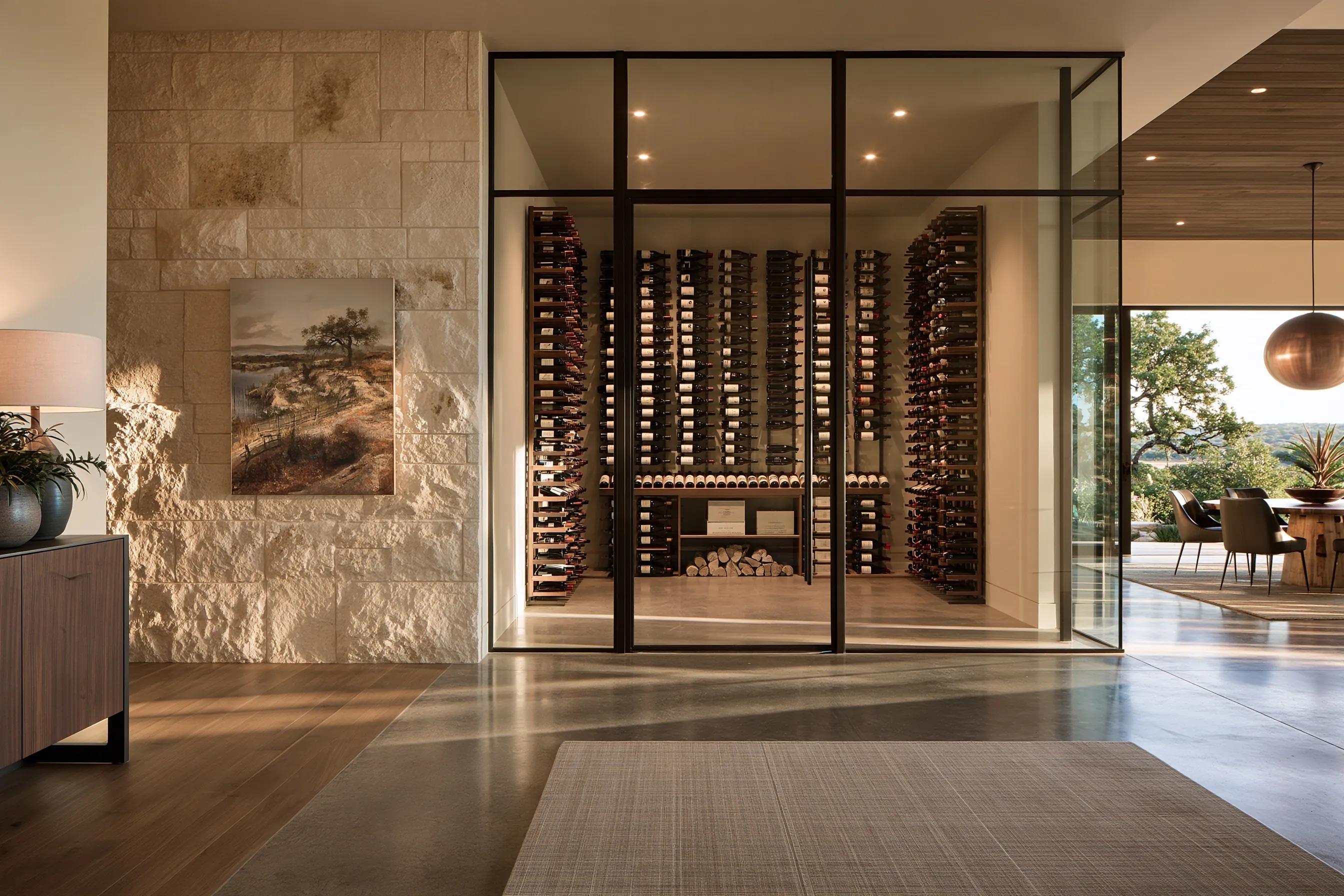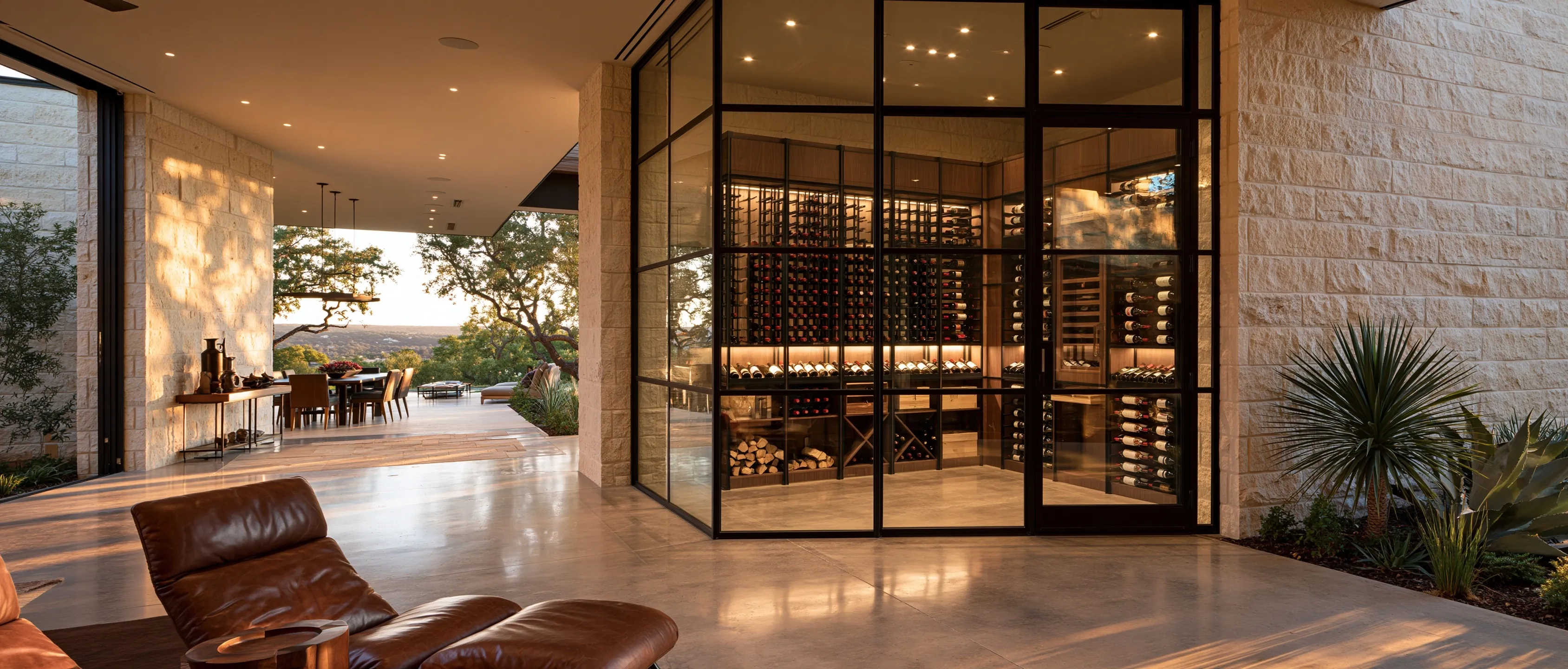
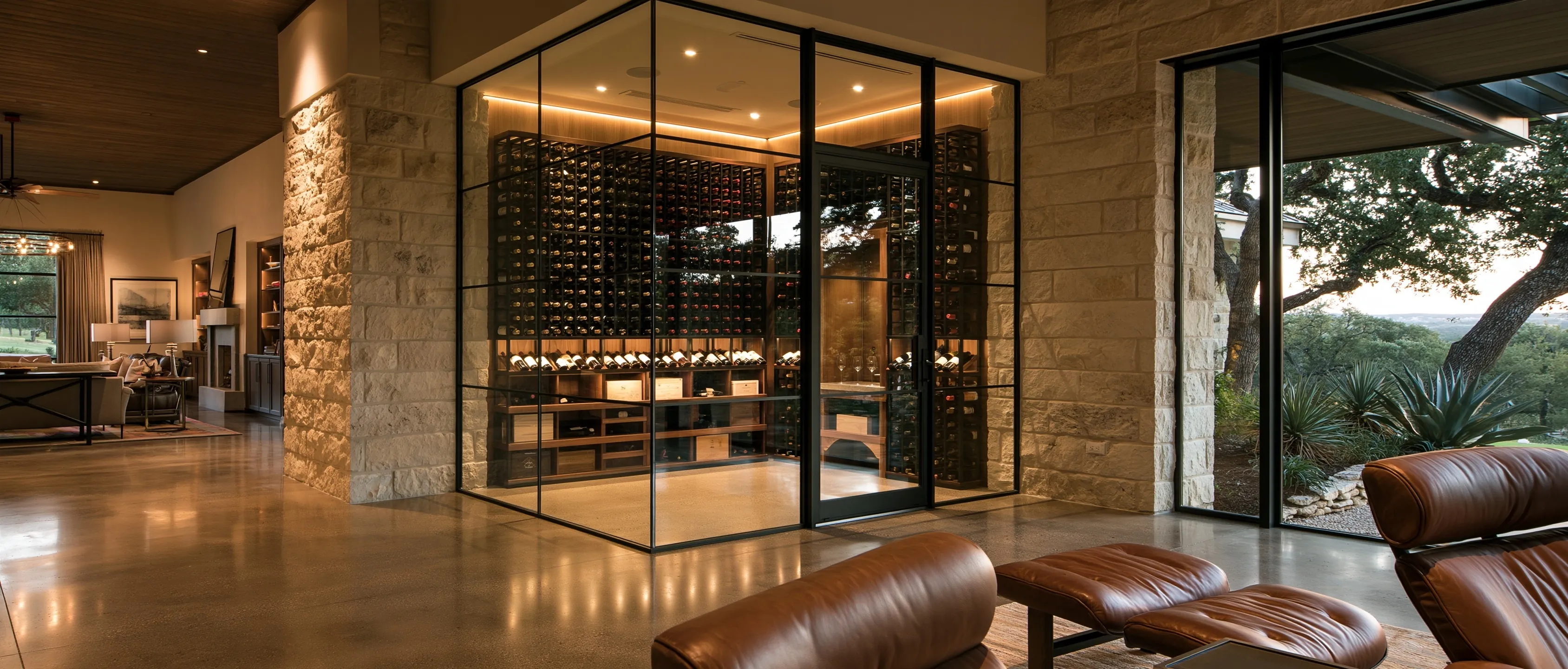
Black steel-framed glass wine room set into a cream limestone wall beside a covered terrace with live oaks and Hill Country views

Custom wine cellars · San Marcos, Texas

San Marcos Wine Cellars: Custom Wine Rooms and Cellars in Hays County

Request a wine cellar quoteExplore wine cellar services

San Marcos Wine Cellars creates custom wine cellars for homes in San Marcos, from a full glass room off the great room to a cooled cabinet in the kitchen. Under the finishes, each is a sealed box: thick insulation in walls and ceiling, a vapor layer, a weatherstripped door rated for exterior use and dedicated cooling that keeps bottles near 55°F, a temperature Wine Spectator says is often cited as close to perfect, with humidity kept moderate.

Here that room is built above ground on a concrete slab and has to hold its temperature through roughly 117 days a year at 90°F or hotter, so we plan the glass, insulation and cooling together, starting with where the cooling system’s heat will go. The wine cellar gallery shows the styles side by side.

What every plan covers

Custom wine cellars and wine rooms

Every option below shares one envelope: insulation, vapor control, a sealed door and cooling sized to the room. What changes is the space, from a spare bedroom or a glass corner of the great room to a hall closet, a stair void or a kitchen wall, and the cooling that space allows.

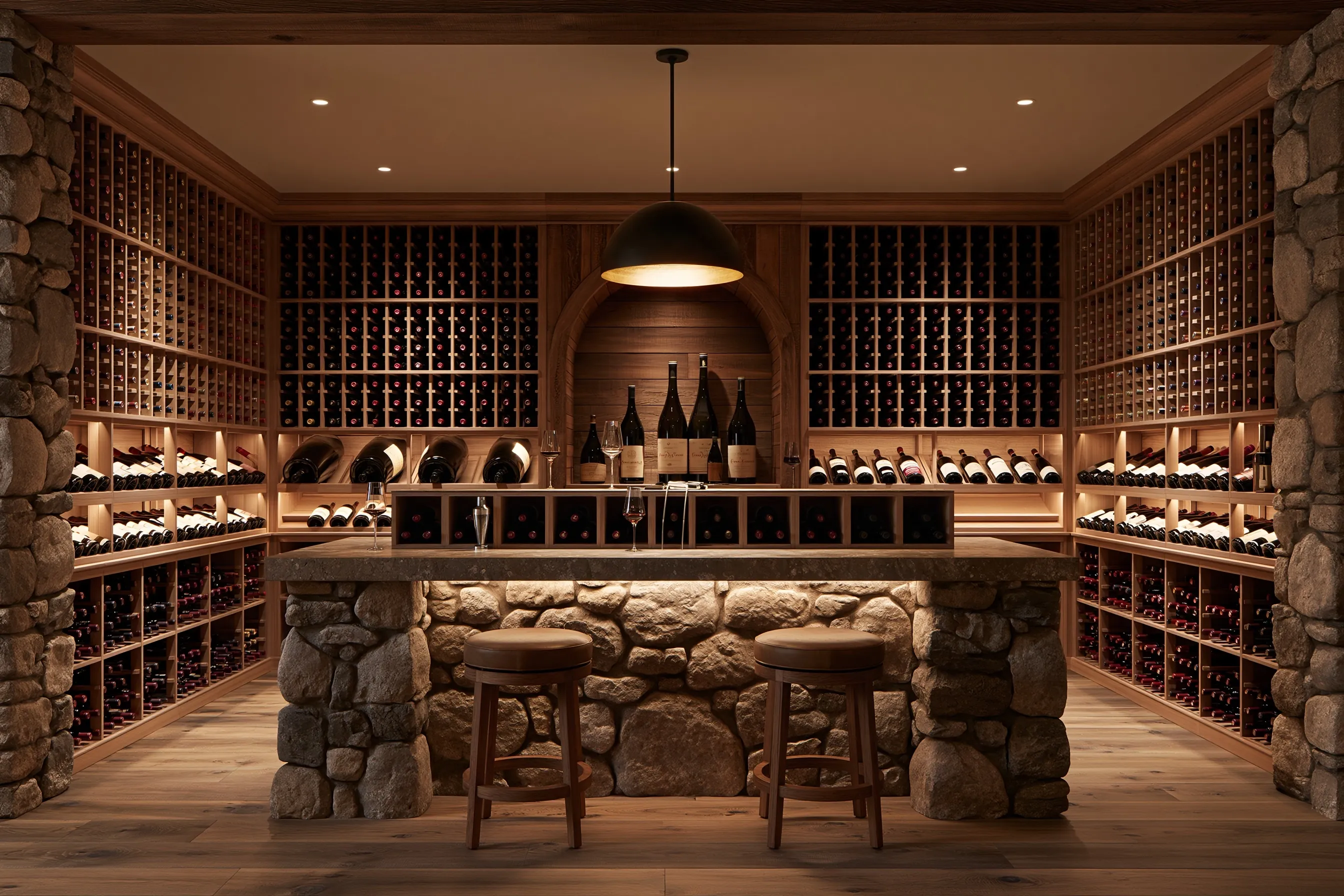
Walk-in wine cellar with wood racking on three walls, an arched niche for large bottles and a stone-based tasting counter with two stools

Walk-in custom wine cellars

A walk-in cellar can start as a spare bedroom, a study or a bonus room. The room gets a second life as a separate envelope: cavities reinsulated to cellar levels, vapor control wrapped without gaps, every outlet and pipe sealed, an insulated exterior-grade door, and cooling plus racking sized for its exact dimensions. Tasting counters and bins for large formats fit where the floor plan allows.
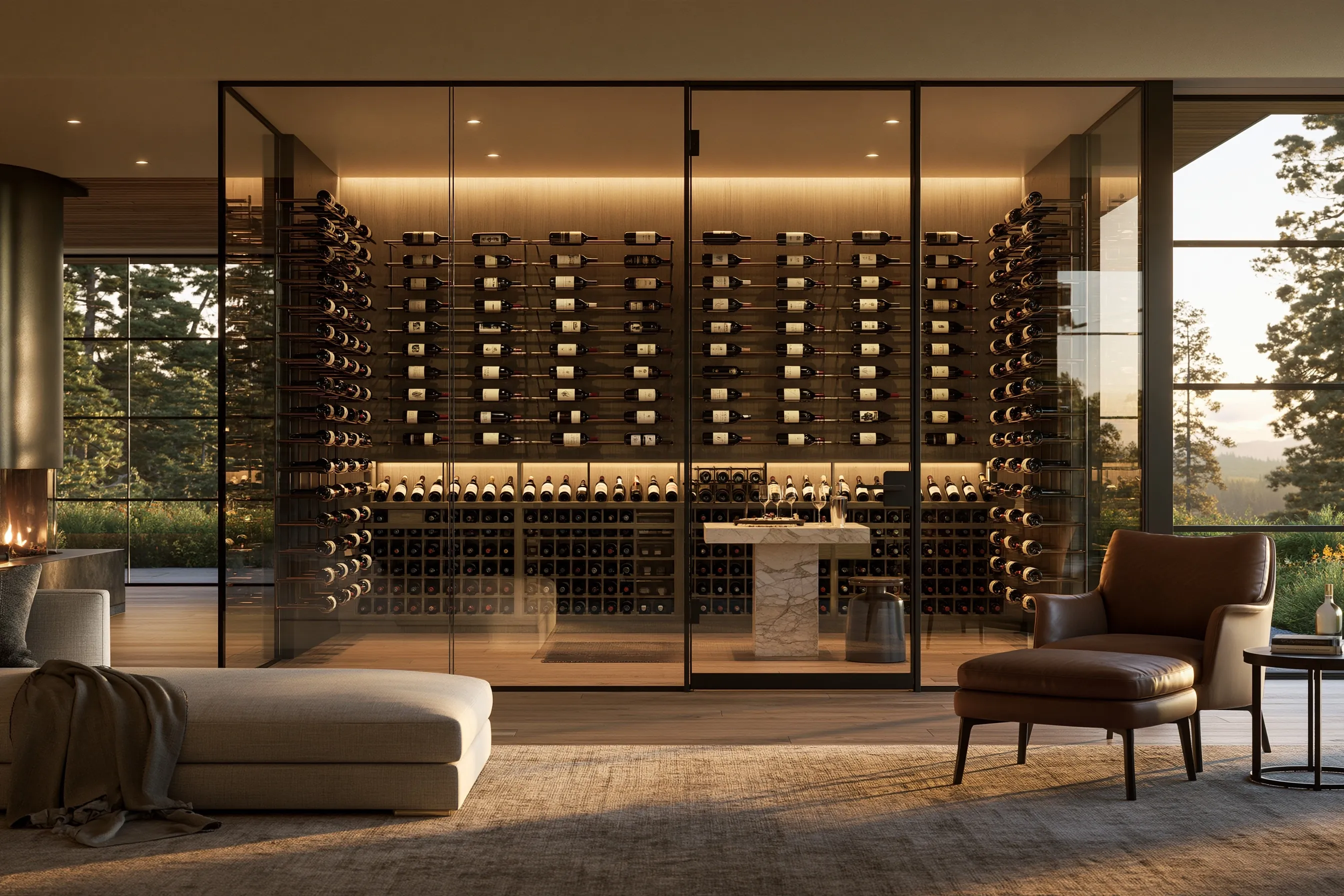
Glass-walled wine room behind a living-room sofa and leather armchair, with floating rods holding bottles label-forward and a marble tasting table inside

Glass wine rooms

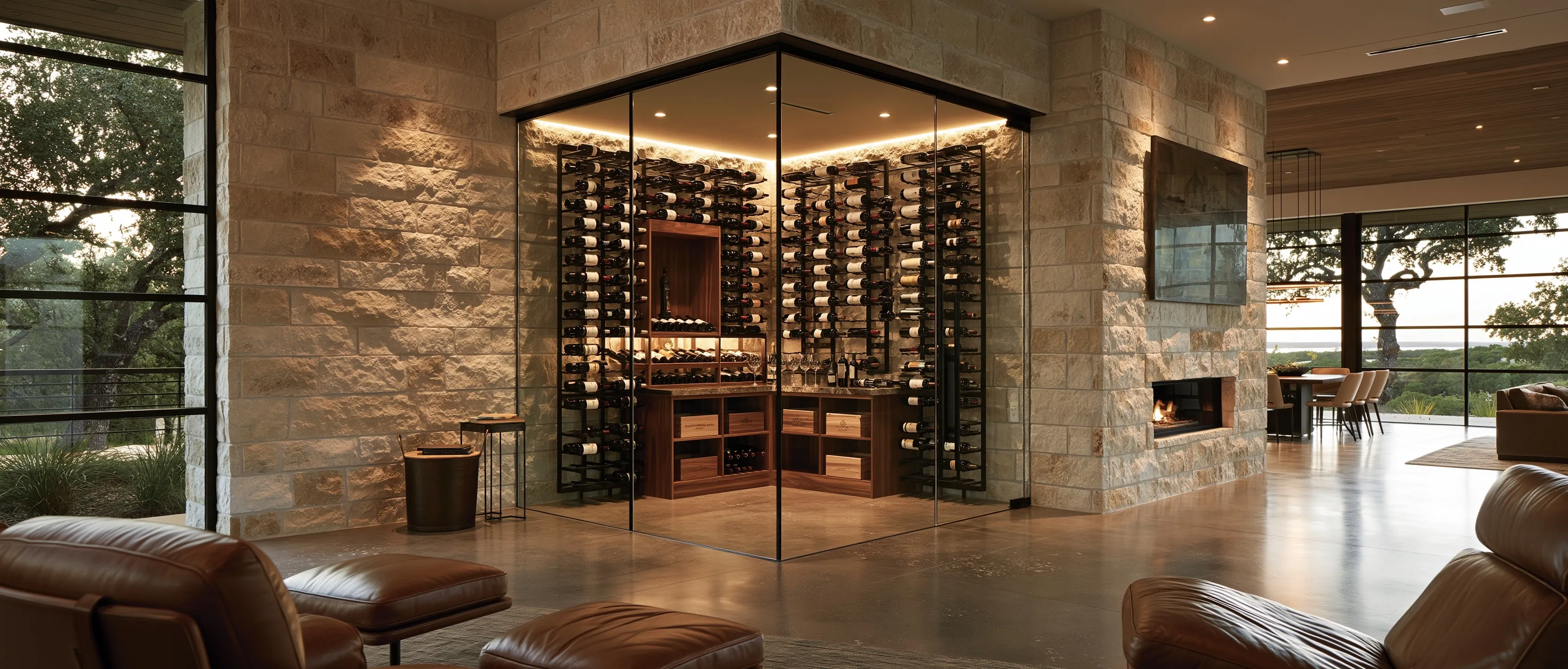
A glass wine room puts the collection on view from a great room, entry or dining area, with insulated glazing on the open sides and a sealed glass door. The ceiling, back wall and floor still get full insulation and vapor control, because glass gives up far more heat than a framed wall. Insulated glazing also keeps the room-side glass warmer, which helps it stay clear on humid days.

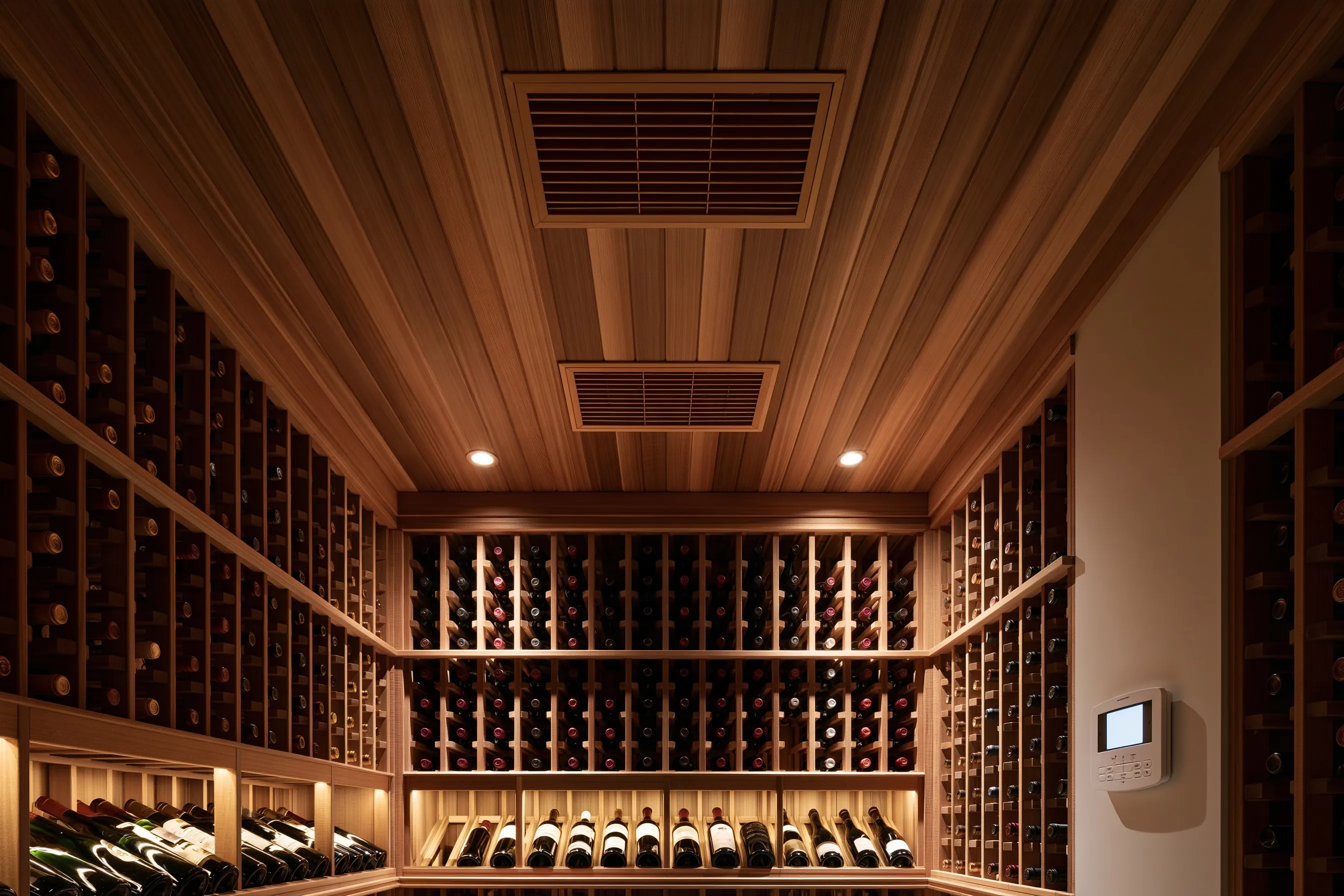
Wood-ceilinged wine cellar with two rectangular cooling grilles overhead, individual-bottle racking on three walls and a wall-mounted controller

Wine cellar cooling systems

Every cooling unit moves heat out of the cellar and dumps it somewhere else, and in Central Texas that somewhere decides the system. A through-wall unit needs a neighboring room at least as large as the cellar that stays cool enough for the unit to work; when no such room exists, the heat is ducted away or sent to a remote condenser through a split system. Each option also brings its own power and condensate drain requirements.

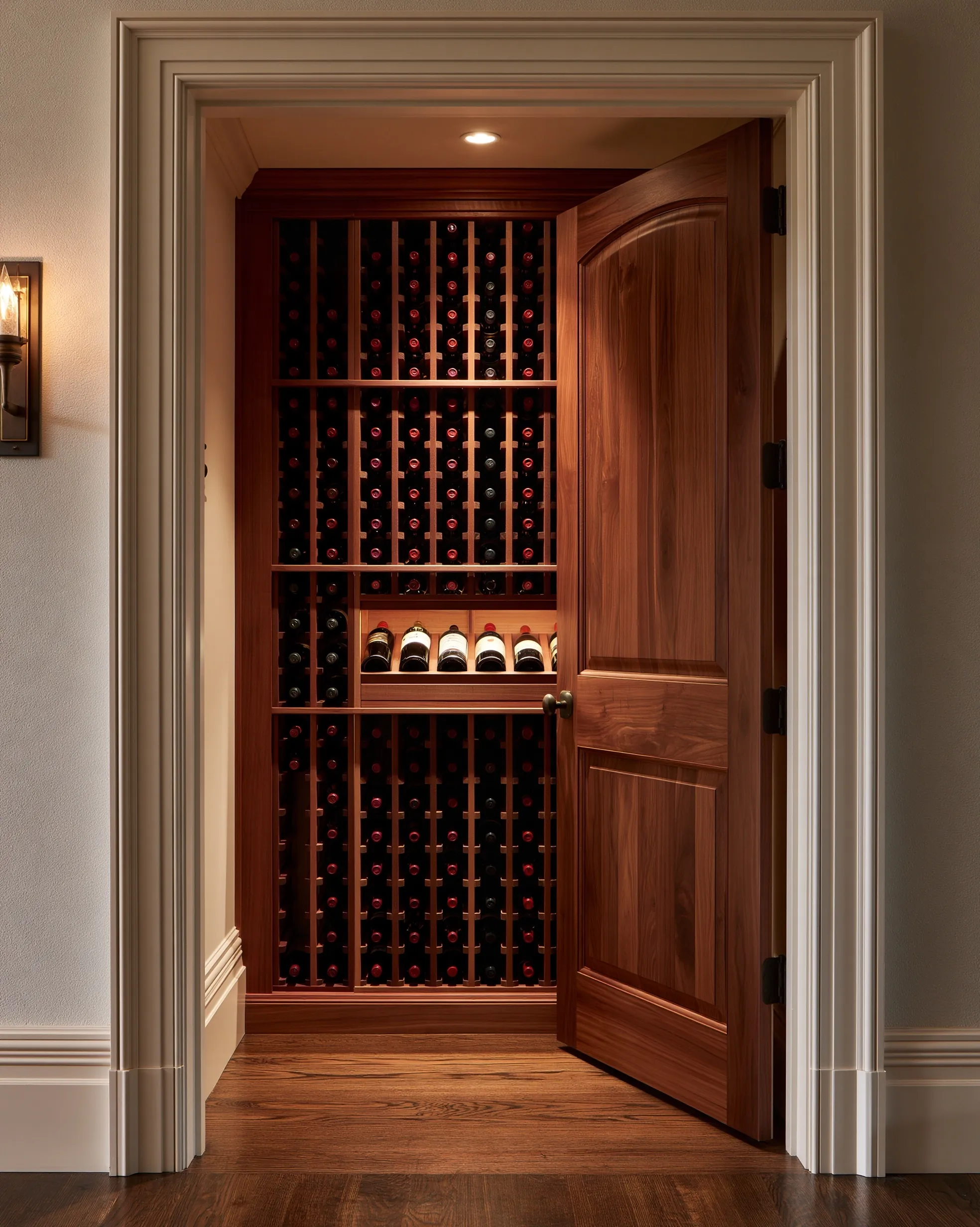
Former hallway closet with an arched-panel wood door open on floor-to-ceiling wood racking and a display shelf

Closet wine cellar conversions

A reach-in hall closet or a small pantry can hold a surprising number of bottles once racking runs from floor to ceiling and front to back. The conversion is more than racking: the hollow door gives way to an insulated, weatherstripped one, the walls are opened for insulation and vapor control, and the cooling unit’s exhaust has to go somewhere other than another closet.

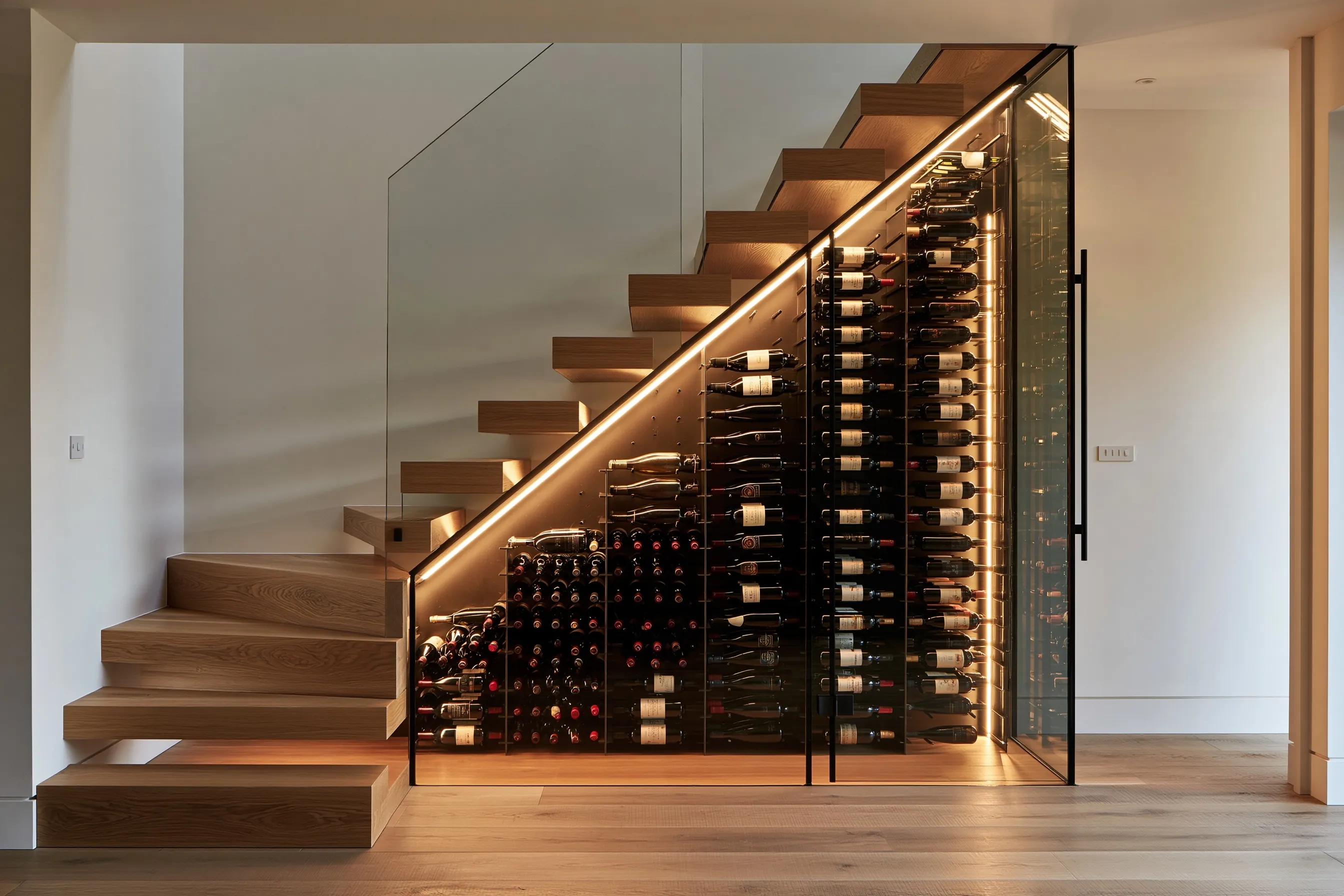
Glass-enclosed wine cellar filling the space beneath a floating oak staircase, with racking stepped to the stair slope and an LED strip along the stringer

Under-stair wine cellars

Beneath a staircase there is a triangle of floor that can hold racking stepped to the slope, closed off by a glass face or a short insulated door. Because open risers let air through, the stair’s underside is sealed and insulated with the rest of the enclosure. A glass front adds heat load, so the cooling is sized for it.

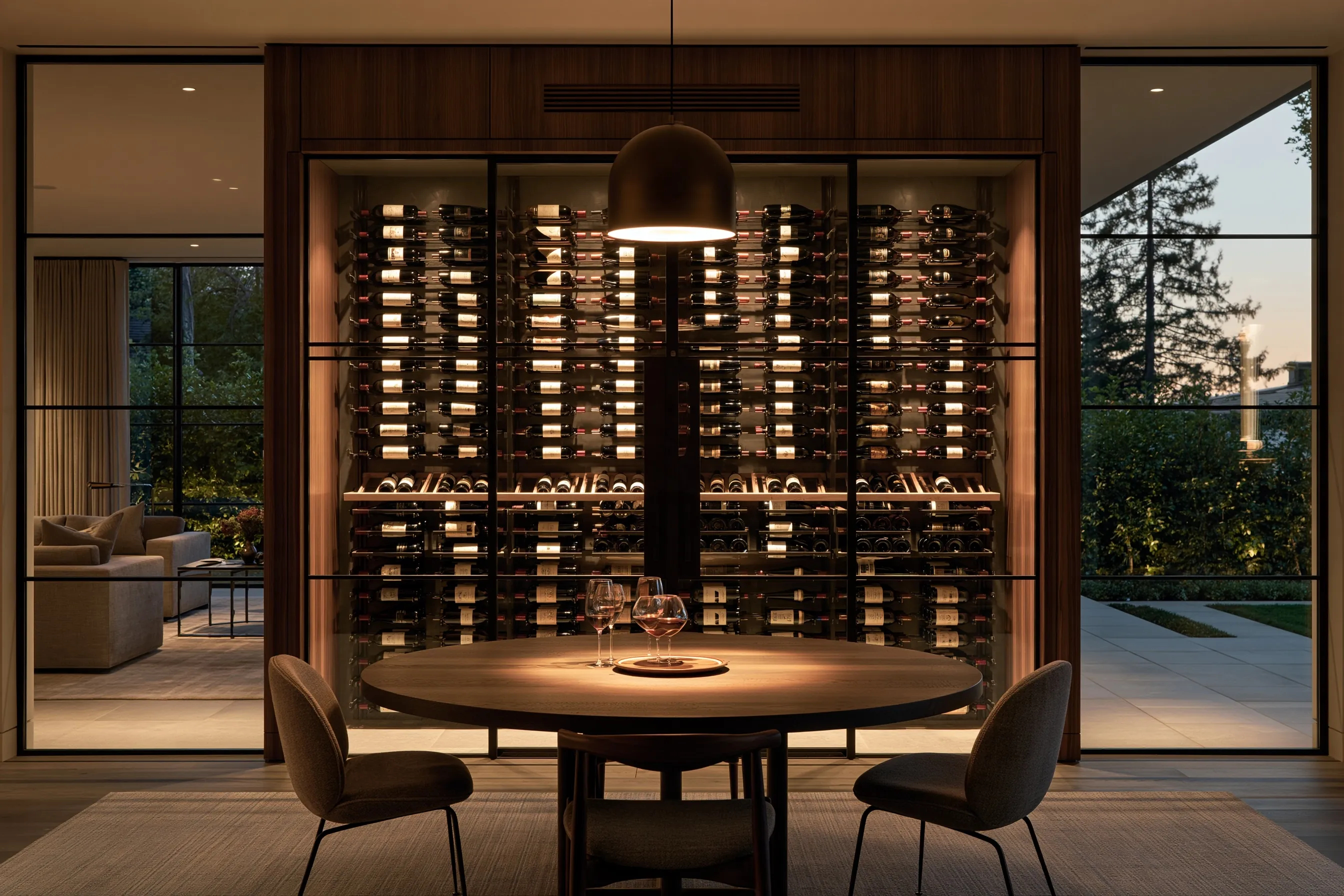
Floor-to-ceiling dining-room wine wall in walnut cabinetry behind black-framed glass, with a supply grille above and a round table in front

Custom wine walls

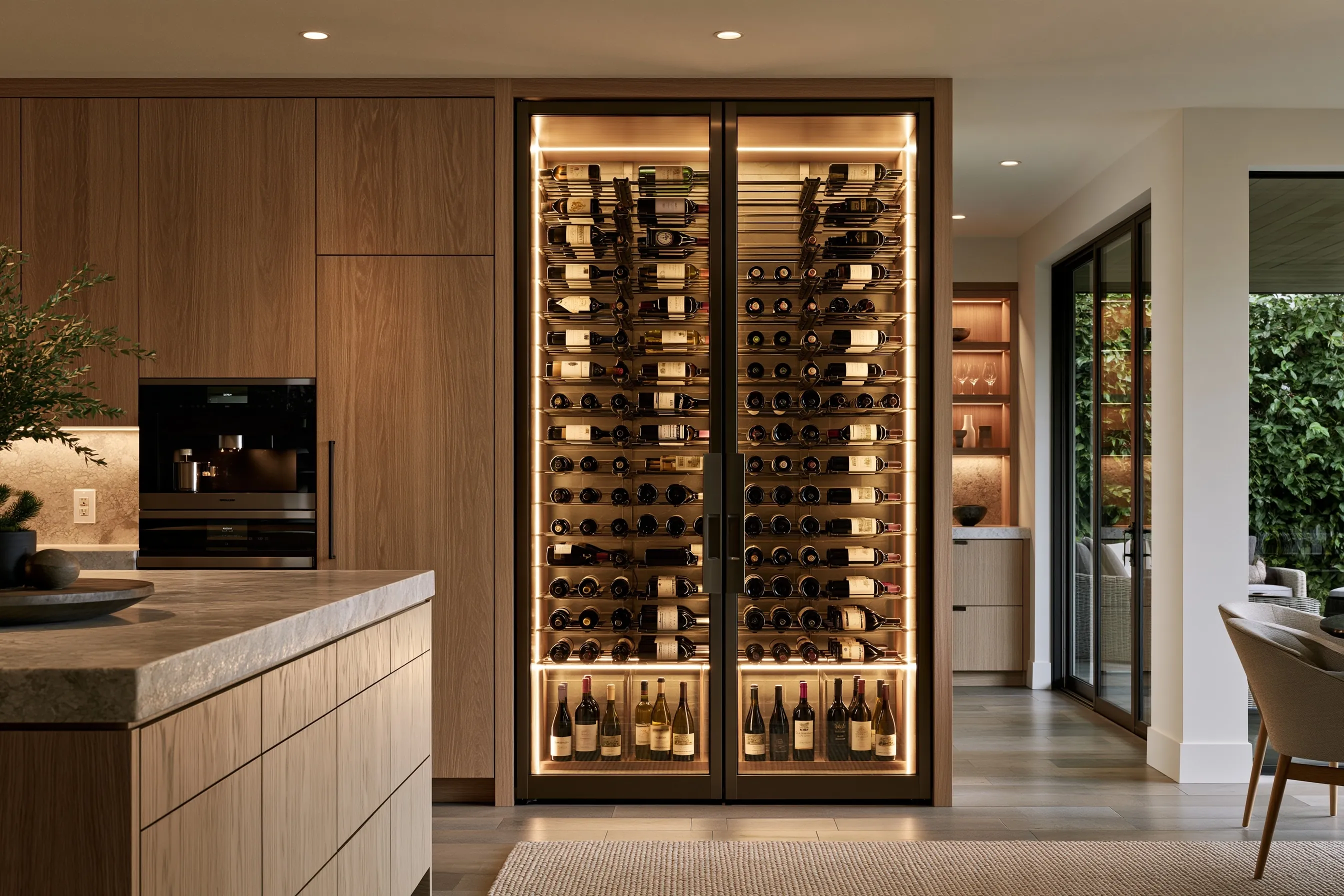
Where there is no room to walk into, a wine wall gives reach-in storage built into kitchen or dining-room millwork, closed by insulated glass doors and cooled by its own small system. Open, uncooled display walls also have a place, for bottles that will be opened in the coming months.

Limestone, steel and glass suit Hill Country interiors; the gallery groups glass rooms, wine walls and compact cellars so you can point to a direction.

Steel-framed glass wine room off a limestone-walled entry hall, with tall racking and a dining area opening toward oak trees
Two-door glass wine cabinet built into oak kitchen cabinetry beside a wall oven, with lit bottles on metal racks
Corner glass wine room with slim black frames between limestone piers, facing leather lounge chairs

Wine cellar racking, doors and lighting

Racking, the door and the lights finish every cellar above. Each is chosen with the room it goes in.

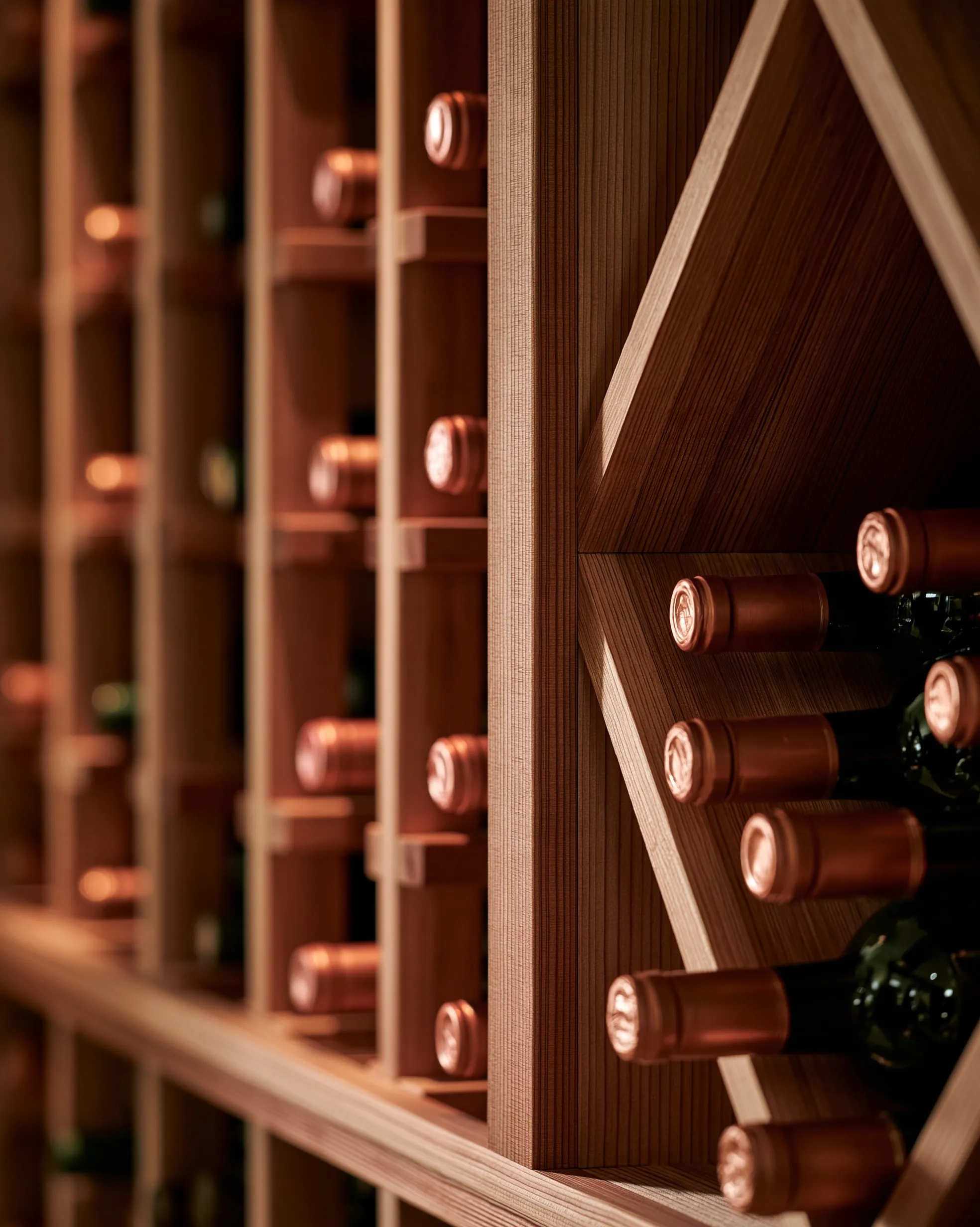
Close view of wood racking with individual bottle slots beside a diamond bin of stacked bottles

Custom wine racking

Individual slots suit collections of mixed bottles, diamond bins hold cases of one wine compactly, and label-forward pegs show bottles off at the front. Bin capacity changes with format: one retailer’s 13½-inch-deep diamond bin holds 9 magnums, 12 Champagne or 16 standard Bordeaux bottles. Redwood and mahogany are chosen for stability and low odor, with water-based finishes if stained.

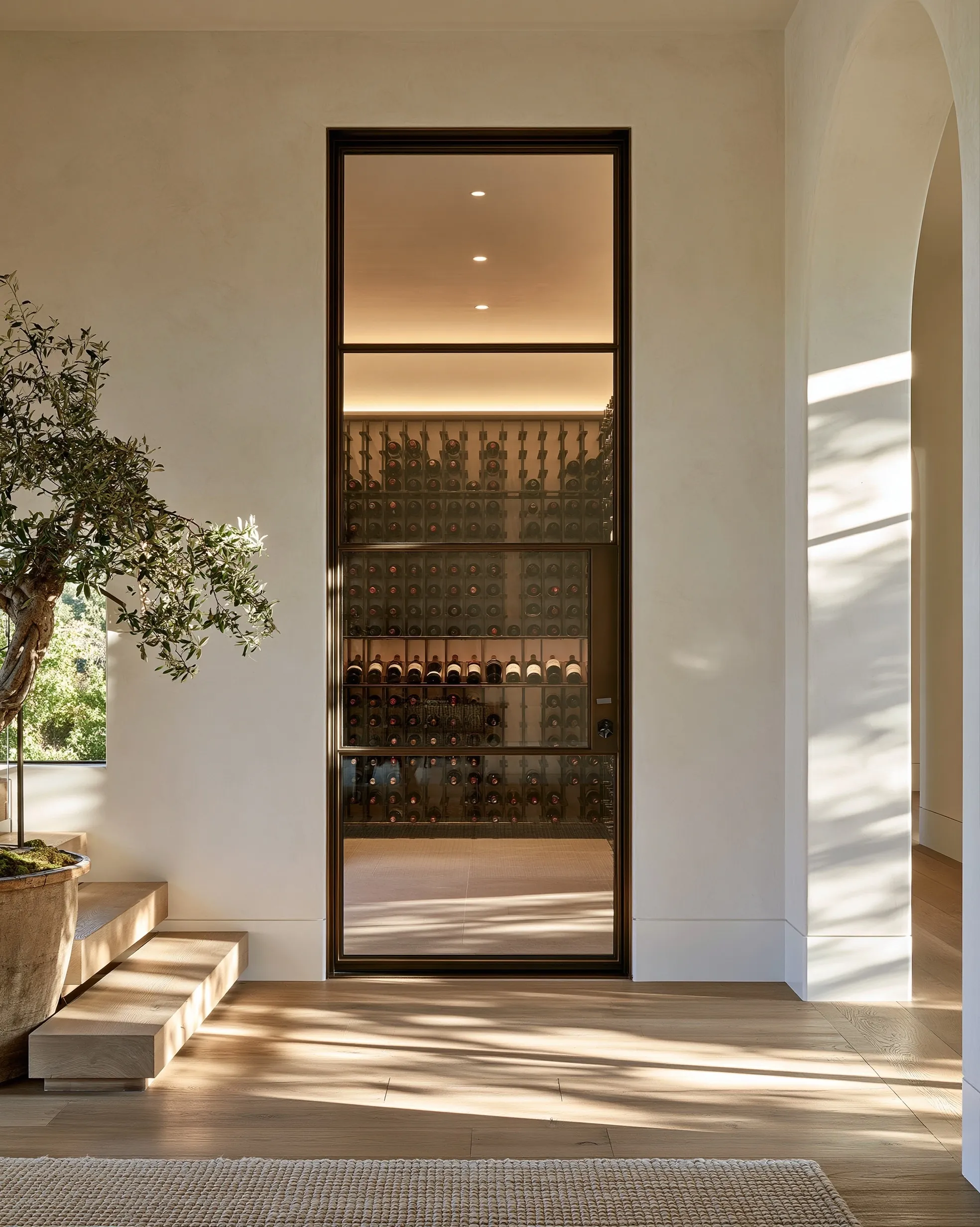
Tall bronze-framed glass cellar door set in a plaster hallway, showing lit racking through the glass

Cellar doors and glass fronts

The door is the weakest point in the envelope. One manufacturer requires an exterior-grade 1¾-inch door weatherstripped on all four sides with a bottom sweep, and warns that a leaky door can keep the unit running nonstop. Insulation values vary widely: about R-3 for a solid-core wood door and R-1.6 to R-3.1 for double glazing, against roughly R-15 for a 2-inch urethane-filled metal door.

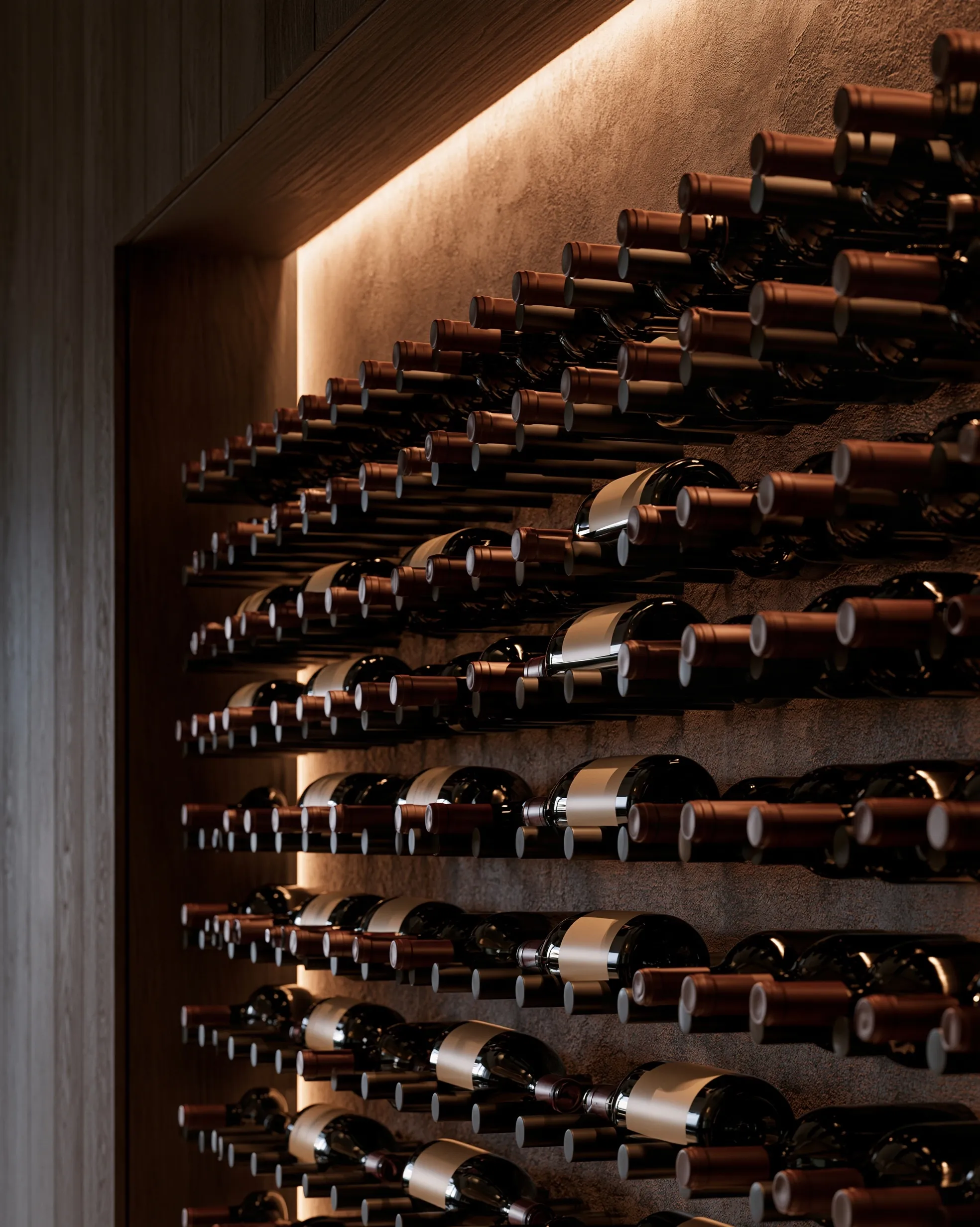
Matte black metal pegs holding wine bottles neck-first in rows against a plaster wall, lit by a hidden warm LED strip

Cellar lighting

Light, especially the ultraviolet in daylight and fluorescent tubes, can age wine, so cellar lighting stays low and on a timer or motion sensor. A 2026 study found warm amber LED far gentler on white wine than cool-white light. Surface-mounted strips and fixtures are used instead of recessed cans, which let warm air leak into the cellar.

How a custom wine cellar build works

Space and heat assessment

We look at the room or void you have in mind: which walls face outside or the attic, how much glass you want, the slab beneath it and where cooling equipment and its heat could go.

Layout and racking plan

How many bottles, and in which sizes (750 ml, magnums, Champagne), decides the mix of slots and bins, where the door goes and whether there is space for display or tasting.

Framing, insulation and vapor control

Walls and ceiling are insulated to the cooling maker’s minimums or better, wrapped in vapor control and sealed at every penetration before finishes go on.

Cooling, power and drainage

Equipment is chosen from the room’s calculated heat load, then wired to its dedicated circuit, piped to a condensate drain and, for split systems, put through the city’s mechanical permit.

Racking, glass, door and lighting

Racking is anchored, glass and the door are set and sealed, and low-heat lighting is wired on a timer or sensor.

Start-up and settling

Expect a slow first pull-down. CellarPro’s manual says a new installation may run without stopping for as long as a week, and that once things settle a run time of up to three-quarters of the time is normal.

Building a wine cellar without a basement

Below-ground cellars are close to absent here. In the 2013 American Housing Survey for the Austin metro, which includes Hays County, 90.5% of one-unit homes sat on a concrete slab and 0.7% had any basement; in 2024, 97.9% of new single-family homes in the West South Central states were built on slabs. A San Marcos cellar is therefore a room, closet or stair void above grade, and the house around it, not the earth, sets its starting temperature.

The slab still matters. Concrete is neither insulation nor a moisture barrier, an existing slab is hard to insulate from above, and its heat gain has to be counted when the cooling is sized. Where there is no vapor barrier under the slab, one cooling maker recommends sealing it before laying wood or carpet.

Cooling a wine cellar in Central Texas heat

NOAA normals for the San Marcos station put the average August high at 96.8°F and the average August low at 73.7°F, with about 2,974 cooling degree days a year. Summer air is humid as well: hourly normals at San Antonio’s airport, a regional station about 40 miles southwest that publishes dew-point normals, average close to 70°F in July and August. Humid air raises the load on cellar cooling, which is why one manufacturer stresses the vapor barrier in Southern and Gulf states.

Those numbers rule out some shortcuts. A through-wall unit cannot send its heat into an unventilated garage or attic through a Texas summer, since those spaces cannot be counted on to stay under the 85°F exhaust-room limit WhisperKOOL sets for holding 55°F, and an outdoor condenser has to be rated above the afternoon highs it will see. Ducted and split systems that send heat outdoors, or into large air-conditioned rooms, are the practical answer here.

Serving San Marcos and nearby towns

San Marcos Wine Cellars builds wine cellars, glass wine rooms and wine walls in San Marcos, and in nearby Kyle, Buda, Wimberley, New Braunfels, Martindale and Lockhart. San Marcos, the Hays County seat, sits on the Balcones Fault where the Hill Country meets the coastal plains, and the Texas Hill Country viticultural area, which takes in parts of Hays County, uses I-35 as part of its eastern boundary.

Frequently asked questions

What temperature and humidity should a wine cellar hold?

Aim for about 55°F and steadiness. Purdue Extension recommends 50–60°F for long storage, warns that warmer than 60°F speeds maturation and bases its ageing advice on a temperature held constant within about 2–3°F either way. Humidity sources differ: Chubb says 60% give or take 10, Wine Spectator calls 50–80% safe, and Building Science Corporation treats about 70% as the upper limit before paper labels are damaged. Roughly 50–70% satisfies all of them.

Does every wine cellar need a cooling unit?

An uncooled closet simply follows the house, and Purdue notes that temperature swings stress corks. In a San Marcos home that is air-conditioned for comfort, the room still sits well above 55°F, and an outside wall or attic above can heat it further in summer. For long-term storage here, plan on active cooling; an uncooled display rack suits wine you will open soon.

What affects the cost of a custom wine cellar?

Size and bottle count, the amount and type of glass, the cooling system (a through-wall unit versus a ducted or split system with a remote condenser), how much framing and insulation the space needs, racking material and style, the door, lighting and finishes. A quote is built from those choices once the space has been seen.

Is a wine cellar different from a wine fridge?

Yes. A fridge chills wine for a short while; a cellar stores it for years. Wine Spectator gives the kitchen refrigerator about two months before its cold, dry air becomes a problem, notes that a wine cooler may be set up for serving temperatures, and reserves the word cellar for a room or cabinet holding a constant 55°F or so, with humidity control and protection from light and vibration.

Do I need a permit for a wine cellar in San Marcos?

It depends on the work. For unclear scopes, the City of San Marcos offers a Permit Requirement Determination form on which its Planning, Building and Engineering reviewers each decide whether a permit is required. Electrical, plumbing and mechanical work goes on the city’s trade permit application, and under city code the applicant for a mechanical permit must be a state-licensed air conditioning and refrigeration contractor or exempt under state law. Planning & Development Services answers questions at 512.805.2630.

Request a wine cellar quote

Let us know where the wine should live, whether that is a spare bedroom, a hall closet, the wedge under the stairs or a stretch of dining-room wall, how many bottles you are planning for, and the property address. We'll get back to you soon with an estimate or any questions we have. Estimates are free and there's no obligation.

Call (737) 214-1948

Call (737) 214-1948