San Marcos Wine Cellars · Services

Closet Wine Cellar Conversions in San Marcos

Hall closets, pantries and walk-in closets in San Marcos can be rebuilt as cooled cellars by San Marcos Wine Cellars. The framing is already there; what changes is everything that keeps Central Texas heat out: denser insulation, continuous vapor control, an insulated exterior-grade door, sealed outlets and a cooling unit with a safe place to reject its heat.

Closet conversions suit bottle counts that do not justify a room. We convert closets in San Marcos and in Kyle, Buda, Wimberley, New Braunfels and Martindale.

Request a closet conversion quote

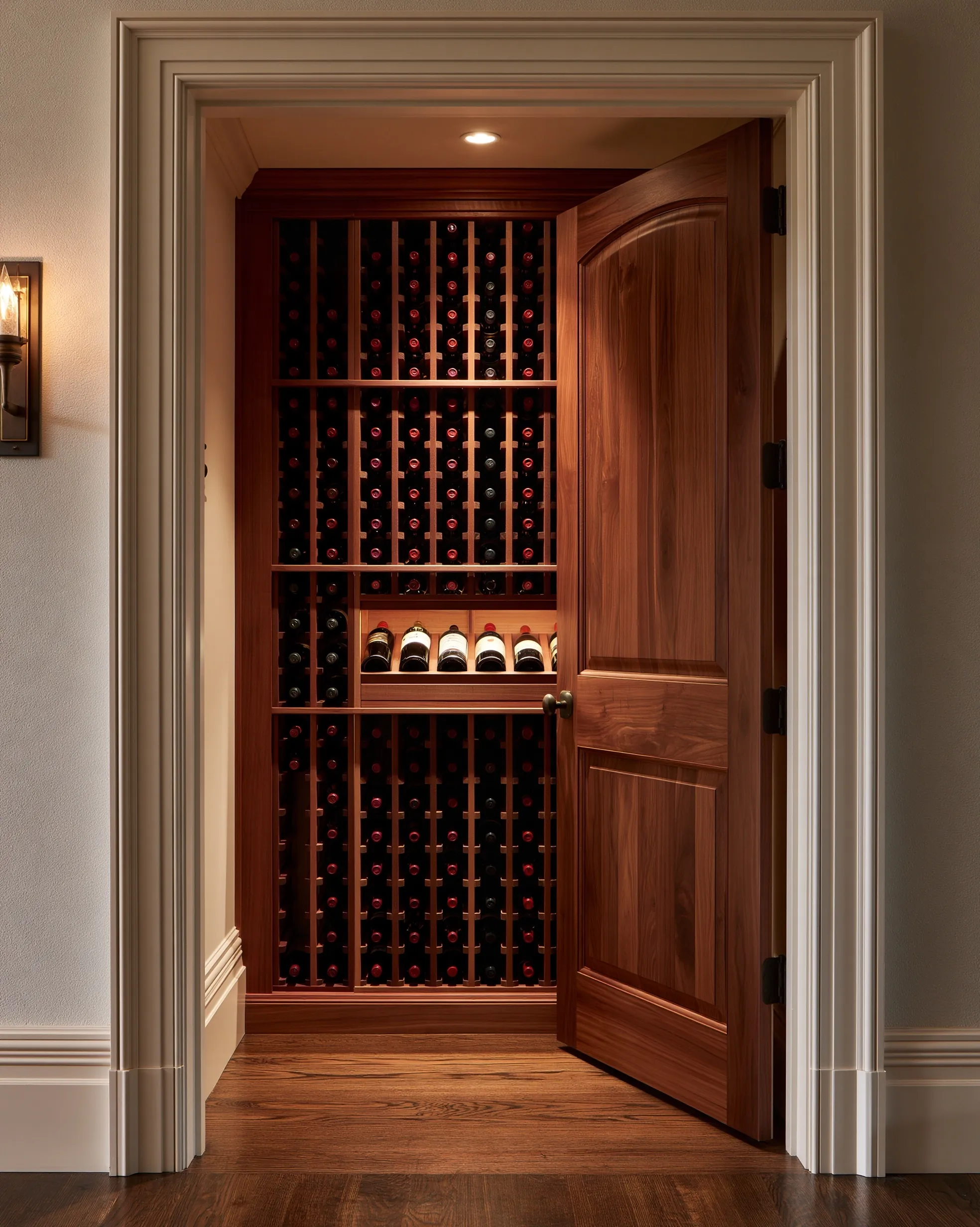
Former hallway closet with an arched-panel wood door open on floor-to-ceiling wood racking and a display shelf

Closet wine cellar conversion options

Reach-in closet conversions

A shallow hall or coat closet takes racking from floor to ceiling and wall to wall, with individual slots and perhaps a display shelf at eye level. The hollow interior door is replaced: one manufacturer requires an exterior-grade 1¾-inch door weatherstripped on four sides with a sweep, and another asks for an R-11 door kept to minimum size.

Walk-in closet wine rooms

Step-in closets give enough floor to stand and turn, so racking can line three sides with a display shelf facing the door. Drywall comes off to reach the stud cavities, insulation and an unbroken vapor layer go in, and outlets, switches and pipes are caulked shut, since humid Texas air finds any gap.

Pantry and spare-room conversions

Pantries and spare rooms in Hays County homes are treated as larger closets. Their wallboard deserves attention: Building Science Corporation advises against paper-faced gypsum in a cellar, preferring materials that resist mold such as wood or stone, and cautions that bleach cleaners can cause cork taint (TCA).

Cooling a closet cellar

For a closet, a through-wall unit is tempting because it needs no outdoor equipment. Its hot side, though, has to blow into well-ventilated space no smaller than the closet cellar itself, kept at or below roughly 85°F; Breezaire names unventilated closets, laundry rooms and garages as places that do not qualify. Back the closet onto a big air-conditioned living room and it can work; back it onto a garage and the heat must travel through ducts or a split line instead.

Passive closets

An uncooled closet tracks whatever the thermostat and the afternoon sun do to the house. That rules it out for aging: Purdue Extension bases its guidance on a temperature held constant within about 2–3°F either way, and Wine Spectator puts storage above 70°F in the too-fast category. Treat a passive closet in San Marcos as short-term space for bottles you will open this season, and add cooling for anything you mean to keep.

Closets in slab-on-grade homes

There is no basement to retreat to here: in the Austin metro, 0.7% of one-unit homes in the 2013 American Housing Survey had any basement. That makes interior closets, away from exterior walls and attic hatches, the best candidates, since every outside wall adds heat. The slab floor counts too; Wine Guardian says an existing concrete floor is hard to protect and its heat load belongs in the sizing.

Permits for a closet conversion

For scopes like moving a wall or replacing drywall, San Marcos offers a Permit Requirement Determination form so Planning, Building and Engineering can each confirm whether a permit is needed. A new circuit for the cooling unit goes on the city’s trade permit application, filed by the license holder.

Frequently asked questions

Does a closet wine cellar need its own cooling unit?

Yes, if the wine will stay for more than a few months. Comfort settings in a Texas house sit far warmer than the 50–60°F band Purdue Extension gives for aging, and a closet without cooling has no way to get colder than the rooms around it.

Where does the cooling unit vent?

Somewhere large, ventilated and air-conditioned behind the closet wall, or outside the house by way of a split or ducted system. Breezaire rules out unventilated closets, garages and attics as exhaust spaces, and in a San Marcos summer an unconditioned garage or attic cannot be counted on to stay under 85°F.

What has to change besides the racking?

Nearly everything except where the walls stand. The hollow interior door gives way to an insulated exterior-grade one, stud cavities get insulation and vapor control, penetrations are sealed, and the cooling unit arrives with its own circuit and a drain for the water it pulls from humid air.

Request a closet wine cellar quote

Send a rough width and depth for the closet or pantry, say whether a garage, bathroom or living area lies on the far side of it, and include the street address. We'll get back to you soon with an estimate or any questions we have. Estimates are free and there's no obligation.

Call (737) 214-1948

Call (737) 214-1948