Custom Wine Walls in San Marcos, Texas

Typical cost in San Marcos

  • Open display wall, no cooling, about 100 to 200 bottles$2,400 – $7,100+
  • Cooled wall with glass doors, 4 to 6 ft wide, 150 to 300 bottles$11,500 – $28,500+
  • Large cooled wall, 8 to 12 ft wide, 400 to 800 bottles$28,500 – $66,000+

A wine wall is reach-in bottle storage built into kitchen cabinetry or along a dining-room wall, closed by insulated glass doors and chilled by a small system of its own. Nobody walks in; the whole cellar is a sealed cabinet one or two bottles deep.

Wine walls fit homes with no spare room or closet to give up. We design and build them in San Marcos and in Kyle, Buda, Wimberley, New Braunfels and Martindale, along with larger wine rooms.

Request a free quote

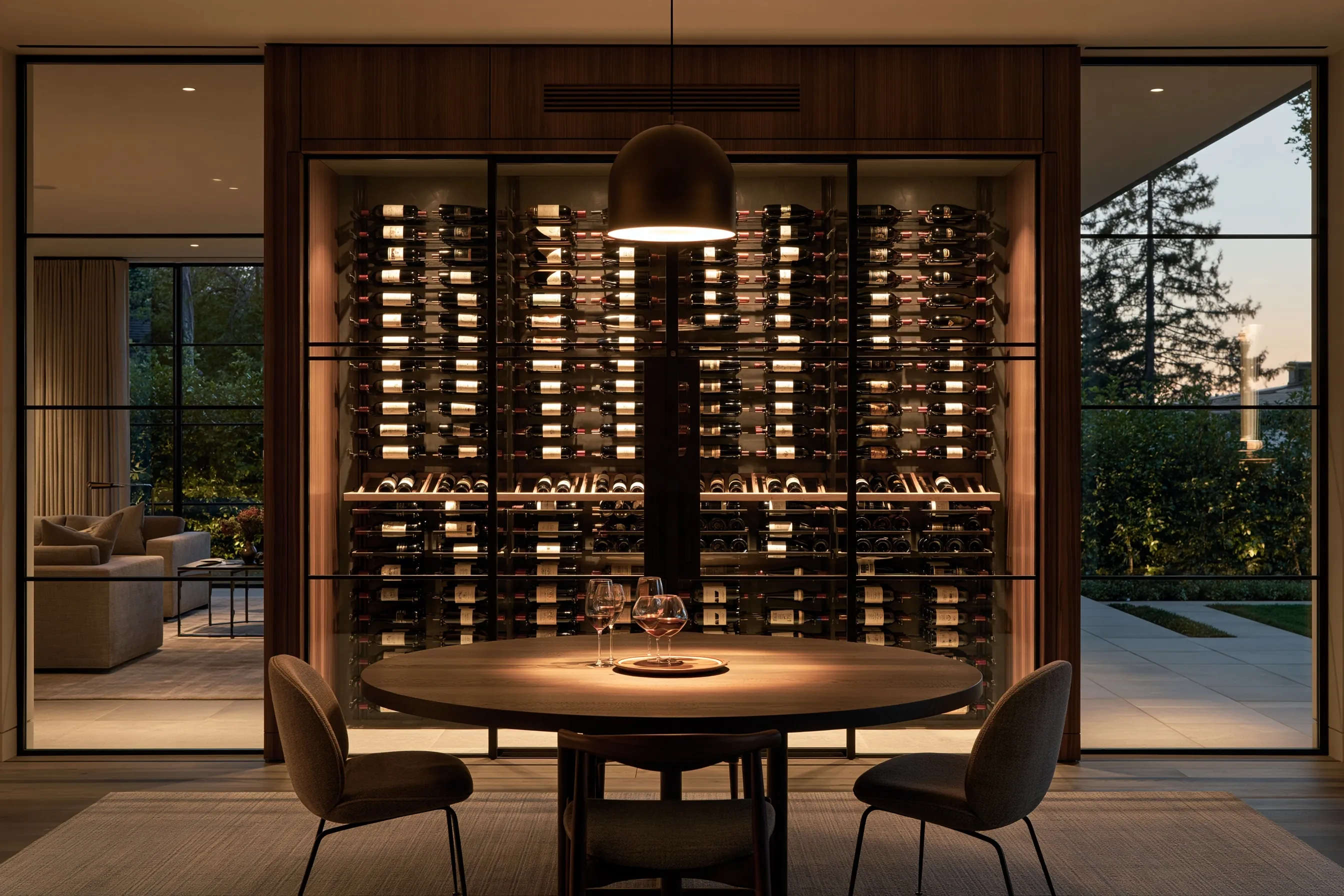
Floor-to-ceiling dining-room wine wall in walnut cabinetry behind black-framed glass, with a supply grille above

Custom wine wall options

Climate-controlled wine walls

The cooled version is a miniature cellar. It is an insulated box behind insulated glass doors, sealed at every joint, with cooling air coming through a grille in the header. Long-term bottles stay at cellar conditions while the wall stays part of the furniture.

Display wine walls without cooling

Open racking on a wall shows off the bottles but follows the room temperature. Storage above 70°F ages wine too quickly, so an uncooled wall is for bottles you will drink soon.

Kitchen and dining-room wine walls

A wine wall built into cabinetry beside a pantry or across a dining-room wall shares its space with heat sources. Ovens, cooktops and sunny windows nearby add heat, so we plan around where they sit.

Racking for wine walls

Racking can be pegs that tilt bottles label-forward, wooden slots that hold them side by side, or a mix, plus a shelf or two for magnums. A full wall gets heavy fast, so we fix the racks into studs or into blocking added behind the finish, never into drywall alone.

Cooling a wine wall

The enclosed volume is small, but a self-contained unit beside the dining table would blow heat and noise into the room. Ducted or split systems keep the condenser elsewhere, outdoors or in a utility space, and bring only conditioned air to the wall. The unit’s manual sets the power: some makers want a dedicated circuit, others a grounded outlet of adequate capacity. The condensate also needs a drain.

Wine wall vs wine fridge

A freestanding wine cooler is an appliance that holds a steady temperature, sometimes set for serving. A cellar keeps wine near 55°F with humidity control for long-term aging. A built-in wine wall is closer to a cellar, sized to the space and the collection, though it takes construction. For long storage, the wall is the better match.

Wine walls in kitchens and dining rooms

In San Marcos the outdoor condenser of a split system works through August afternoons that average 96.8°F, so its rating, its shade and its placement all matter.

Permits for wine walls

A plug-in cooling unit and cabinetry may need no permit, but new circuits and split systems are trade work and go on the city’s trade permit application. The Permit Requirement Determination form settles unclear cases.

Frequently asked questions

How is a wine wall different from a walk-in cellar?

A wine wall is reach-in: bottles sit one or two deep behind doors in a shallow cooled cabinet. A walk-in cellar is a room you enter.

Does a wine wall need cooling?

For long-term storage, yes. An open display wall follows the room temperature and suits wine you plan to open within months.

Can a wine wall go in a kitchen?

Yes, with the cooling sized for nearby heat sources such as ovens and cooktops, and with the condenser kept out of the kitchen.

Request a free wine cellar quote

Tell us whether the wall is in a kitchen, a dining room or somewhere else, how many bottles you hope to store, and the address. We'll get back to you soon with an estimate or any questions we have. Estimates are free and there's no obligation.

Call (737) 214-1948

Call (737) 214-1948