San Marcos Wine Cellars · Services

Wine Cellar Cooling Systems in San Marcos

San Marcos Wine Cellars chooses and fits cooling for wine cellars in San Marcos, from compact through-wall units to ducted self-contained units and split systems with outdoor condensers, all meant to hold about 55°F without drying the air. In this climate the right one depends on a single question: where can the heat taken out of the cellar safely go?

We also plan the dedicated circuit, condensate drain and permits that come with the equipment, for cellars, closets and wine walls in San Marcos and in Kyle, Buda, Wimberley, New Braunfels and Martindale.

Request a cooling quote

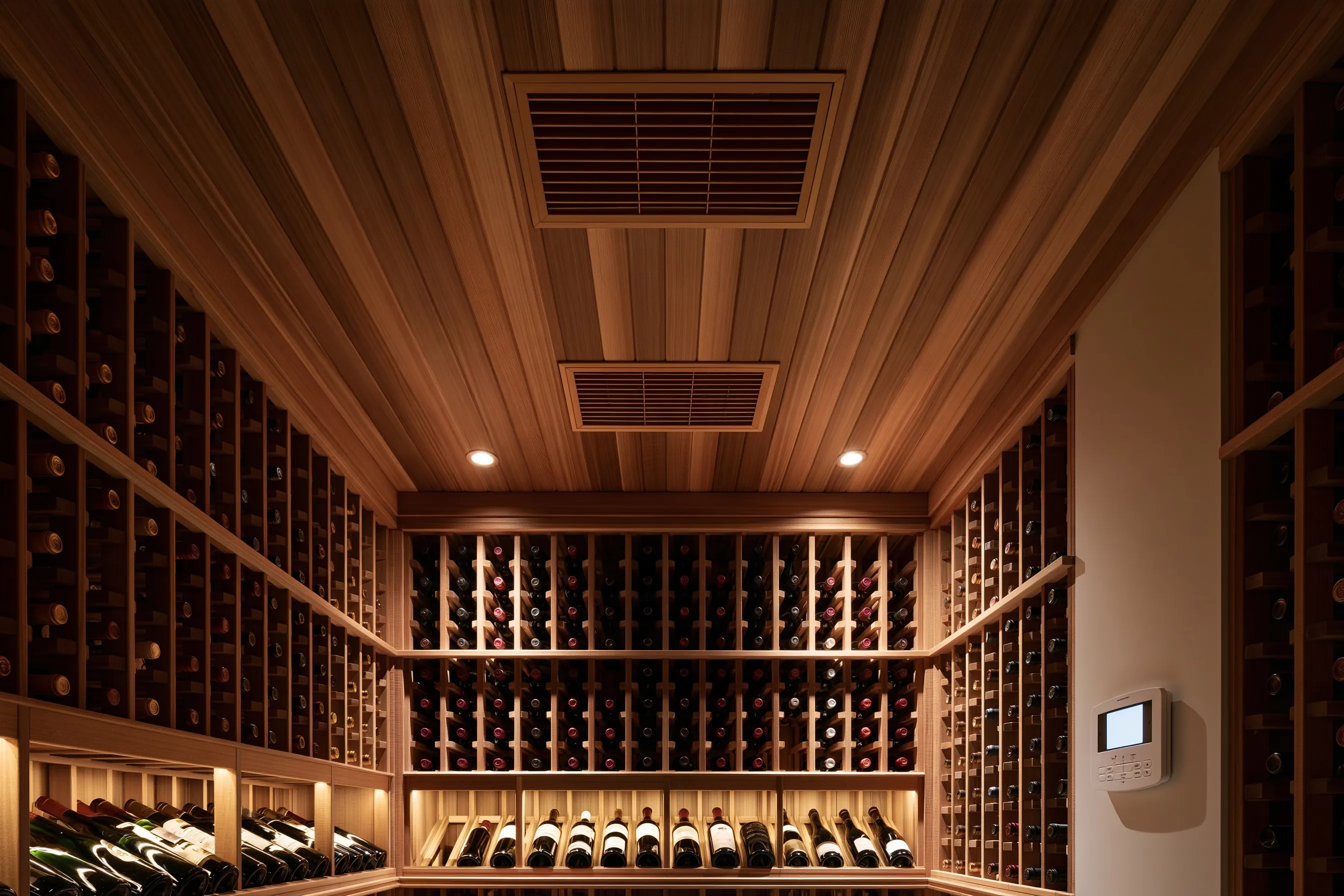
Wood-ceilinged wine cellar with two rectangular cooling grilles overhead, slot racking below and a wall-mounted controller

Wine cellar cooling system options

Self-contained through-wall units

This is the simplest equipment: one box set through the cellar wall, pushing heat into the room behind. CellarPro wants that room at least as big as the cellar unless the hot side is ducted, and WhisperKOOL’s limit for its exhaust room is 85°F if the cellar is to stay at 55°F. In a San Marcos house that points to a large, air-conditioned living space; a closet, garage or attic does not qualify.

Ducted self-contained units

Here the complete unit lives outside the cellar, in an attic or utility room, linked by a supply duct and a return. The surroundings still count: WhisperKOOL’s Phantom holds 55°F only while its own location stays between 42°F and 110°F. A conditioned utility room meets that easily; an unconditioned attic in a Texas summer has to be checked against the upper figure first.

Split systems

Only the evaporator goes inside the cellar. A refrigerant line set links it to a condensing unit outdoors or in a ventilated remote room, much as central air links an indoor coil to the unit by the patio. WhisperKOOL rates its ceiling-mount model to keep 55°F in ambient air up to 110°F, comfortably above a San Marcos August. Manufacturers require certified HVAC-R technicians as installers, and EPA Section 608 certification applies to adding refrigerant or connecting lines.

Ducted split systems

Take the split one step further and the evaporator moves out too, joined to the cellar by ducts, so only supply and return grilles show and the condenser sits outdoors. It is the quietest layout, and Wine Guardian names it as the fit for glass rooms that have no easy way to exhaust condenser air.

Replacing or upgrading an existing unit

A unit that runs constantly, ices up or leaks water may be undersized, or may be fighting a leaky envelope. CellarPro links poor sealing to excess condensate and shortened unit life, so we check the door seals, insulation and vapor control before sizing a replacement to the room’s actual load.

Sizing and heat load

Sizing starts with volume, then adjusts for insulation levels, glass, walls facing outside or the attic, and the temperature around the cellar. Manufacturers publish tables for rooms that meet their minimum construction, such as R-11 to R-13 walls and R-19 ceilings, and CellarPro’s tables assume an 85°F peak around the room. Anything outside those assumptions, glass above all, calls for a custom heat-load calculation, and an undersized unit is not covered by WhisperKOOL’s warranty.

Long running is normal. According to CellarPro, a freshly installed unit may not cycle off for up to a week while it pulls the room down, and afterward running three-quarters of the time is within the expected range.

Why not a home AC or mini-split

Air conditioners for living spaces are built around human comfort. By Wine Guardian’s account (the company sells cellar units), a comfort mini-split is tuned for roughly 72°F, seldom reaches 55–58°F and dries air to 50% humidity or below. Wine Spectator says a window unit bottoms out near 62°F and can leave a room around 35% humidity, dry enough to crack or crumble corks. Cellar equipment is designed to sit at 55°F with humidity kept moderate.

Electrical, drains and permits

Dedicated circuits

Circuit requirements come from the unit chosen. CellarPro asks for a dedicated 15-amp circuit for its 1800 series; WhisperKOOL’s Phantom needs a dedicated 115-volt, 20-amp circuit, and its ceiling-mount split takes two, one for the evaporator inside and one for the outdoor condenser. Wiring follows that manual and the 2020 National Electrical Code that San Marcos has adopted.

Condensate drains

Cooling pulls water from the air, and in humid Central Texas air that water has to go somewhere. WhisperKOOL requires a drain line on its ducted and split evaporators; CellarPro recommends drain lines in warm or humid settings; Wine Guardian runs its drain to an external drain, with an optional pump on its own outlet.

San Marcos permits

Through-wall plug-in units are not addressed in the city sources we read. For split and ducted systems, San Marcos code requires the mechanical permit applicant to be a state-licensed air conditioning and refrigeration contractor or exempt under state law; an owner who occupies the house as a homestead and does the work personally files an affidavit. The city’s single trade permit application covers electrical, plumbing and mechanical work.

Cooling through a Central Texas summer

NOAA’s San Marcos normals count about 117 days each year reaching 90°F, and the average August low is 73.7°F, so nights give equipment little relief. CellarPro rates its 1800 series, exterior model included, to 95°F ambient, under the 96.8°F average August high; WhisperKOOL rates its split to 110°F. Matching the condenser’s rating to local highs, and shading it, is part of every outdoor installation here.

Humidity adds a second load. WhisperKOOL notes that in Southern and Gulf states warm, moist air infiltrating the cellar significantly increases the heat load, which is why the vapor barrier and air sealing are finished before any unit is sized.

Frequently asked questions

Which type of cooling system do I need?

Work backward from the heat. A big air-conditioned room behind the cellar wall can take a through-wall unit’s exhaust; a conditioned utility room can house a ducted self-contained unit; with neither available, a split or ducted split carries the heat to an outdoor condenser.

Can I use a regular mini-split?

Not in place of cellar equipment. A comfort mini-split is designed to keep people near 72°F and to dry the room, whereas bottles want 55°F with humidity held in a moderate range, two targets the comfort unit was never built for.

Does a cooling unit need its own circuit?

It depends on the make. Breezaire only asks for a properly grounded outlet of adequate capacity, whereas WhisperKOOL and CellarPro specify a dedicated circuit and Wine Guardian a dedicated outlet sized for its unit, so the manual for the model chosen decides.

Request a wine cellar cooling quote

Roughly how big is the cellar, is any of it glass, where could a unit or condenser sit, and what is the address? We'll get back to you soon with an estimate or any questions we have. Estimates are free and there's no obligation.

Call (737) 214-1948

Call (737) 214-1948