Under-Stair Wine Cellars in San Marcos, Texas

Typical cost in San Marcos

  • Open racks under the stairs, no cooling, about 100 to 200 bottles$2,400 – $6,600+
  • Enclosed and cooled, glass front, about 150 to 300 bottles$9,500 – $24,000+

The wedge of floor beneath a staircase is a good spot for racking that steps down with the slope. Close it with insulated glass and the collection becomes part of the living area; close it with a framed wall and a small insulated door and it disappears. Either way, once we insulate and seal the underside of the stair, it becomes the cellar ceiling.

An under-stair cellar uses space that otherwise goes to storage. It is one of the custom wine cellars we build in San Marcos and in Kyle, Buda, Wimberley, New Braunfels and Martindale.

Request a free quote

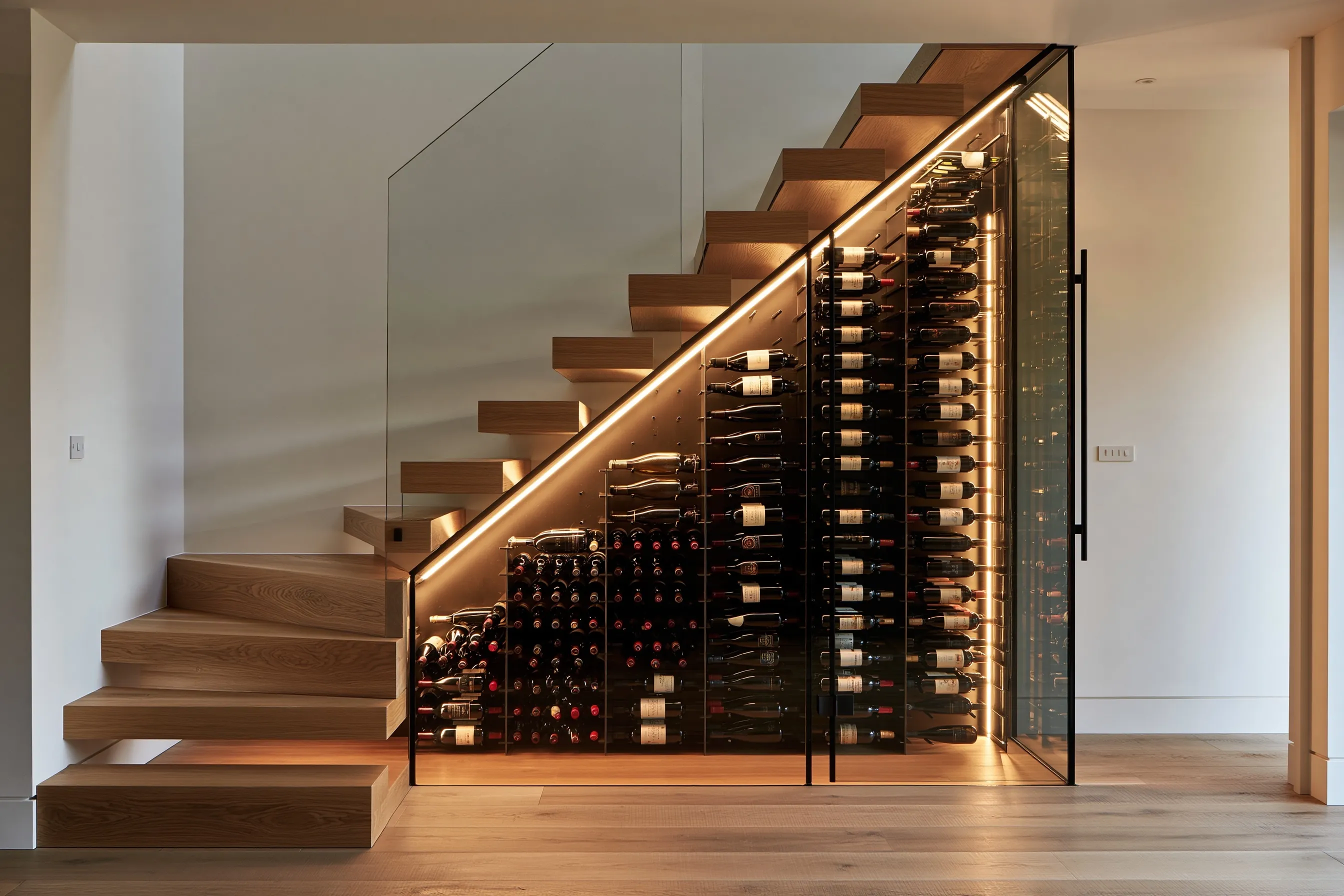
Glass-enclosed wine cellar filling the space beneath a floating oak staircase, with racking stepped to the stair slope

Under-stair wine cellar options

Glass-fronted under-stair cellars

An insulated glass front and a narrow glass door close off the triangle, with LED strips following the stringer. The glass is built the way it is for a full glass room: insulated units rather than single panes, sealed edges and a door weatherstripped on every side.

Enclosed under-stair wine rooms

Solid framed walls with a small insulated door let in the least heat. We insulate the walls, the stair underside and the floor to the cooling maker’s minimums, which run from R-11 for interior walls up to R-19 or R-30 for ceilings, depending on the maker.

Racking that follows the stair slope

Tall slot columns fill the high end of the triangle, then shorten as each tread lowers the ceiling. Diamond bins suit the cramped low corner, where cases of one wine pack in tightly.

Open stairs and closed stairs

If the stair is boxed in with drywall underneath, that sloped ceiling is already there to insulate behind. Floating or open-riser stairs leave gaps between the treads that house air would pour through, so we frame a separate insulated, vapor-sealed lid below them and seal the outlets and light fixtures in the space too.

Cooling under a staircase

An under-stair cellar is small, but its cooling unit still needs somewhere to put heat. A through-wall unit can exhaust into the living room on the other side if that room is large, ventilated and air-conditioned, but not into a closet or storage cupboard beside it. Otherwise we duct the heat away, for example with a remote ducted system placed elsewhere in the house.

Permits for new walls and circuits

Closing in the stair void and adding a circuit are the parts that may need a permit. The city’s Permit Requirement Determination form lists moving an interior wall as one example. If you add a split system, it needs the city’s mechanical permit; see wine cellar cooling systems.

Under-stair cellars in two-story homes

An interior staircase, away from exterior walls and the attic, gives a cellar that starts from house temperature instead of Texas afternoon heat. If the stair also opens onto a large air-conditioned room, a through-wall unit can exhaust into that room.

Frequently asked questions

Where does the cooling unit exhaust under a staircase?

Through-wall heat can go into the big living area beside the stair if that room is air-conditioned and ventilated. A coat closet or cupboard next to it will not work, so the alternative is to duct the heat away or run a split system to an outdoor condenser.

Does an under-stair cellar need cooling?

For storage beyond a few months, yes. The space follows the house temperature, and in a Texas home that stays above the 50–60°F range for long-term storage.

Can it be glass?

Yes. An insulated double-glazed front and a glass door sealed on every edge put the bottles on show, and we size the cooling up for the extra heat glass brings in compared with a framed wall.

Request a free wine cellar quote

Say whether the stair is enclosed underneath or has open risers and which room sits next to it, and give us the home’s address. We'll get back to you soon with an estimate or any questions we have. Estimates are free and there's no obligation.

Call (737) 214-1948

Call (737) 214-1948