San Marcos Wine Cellars · Services

Glass Wine Rooms in San Marcos

San Marcos Wine Cellars wraps walk-in cellars in insulated glazing on one or more sides to create glass wine rooms in San Marcos, closed by a sealed glass door so the racking becomes part of the living space it faces. Behind the glass, the parts you do not see, an insulated ceiling, back wall and floor, vapor control and a properly sized cooling system, are what keep the bottles near 55°F.

Glass is the hardest material to keep cold in a hot, humid climate, so every glass room starts with the glazing make-up and the heat load. We build glass wine rooms across San Marcos and in Kyle, Buda, Wimberley, New Braunfels and Martindale.

Request a glass wine room quote

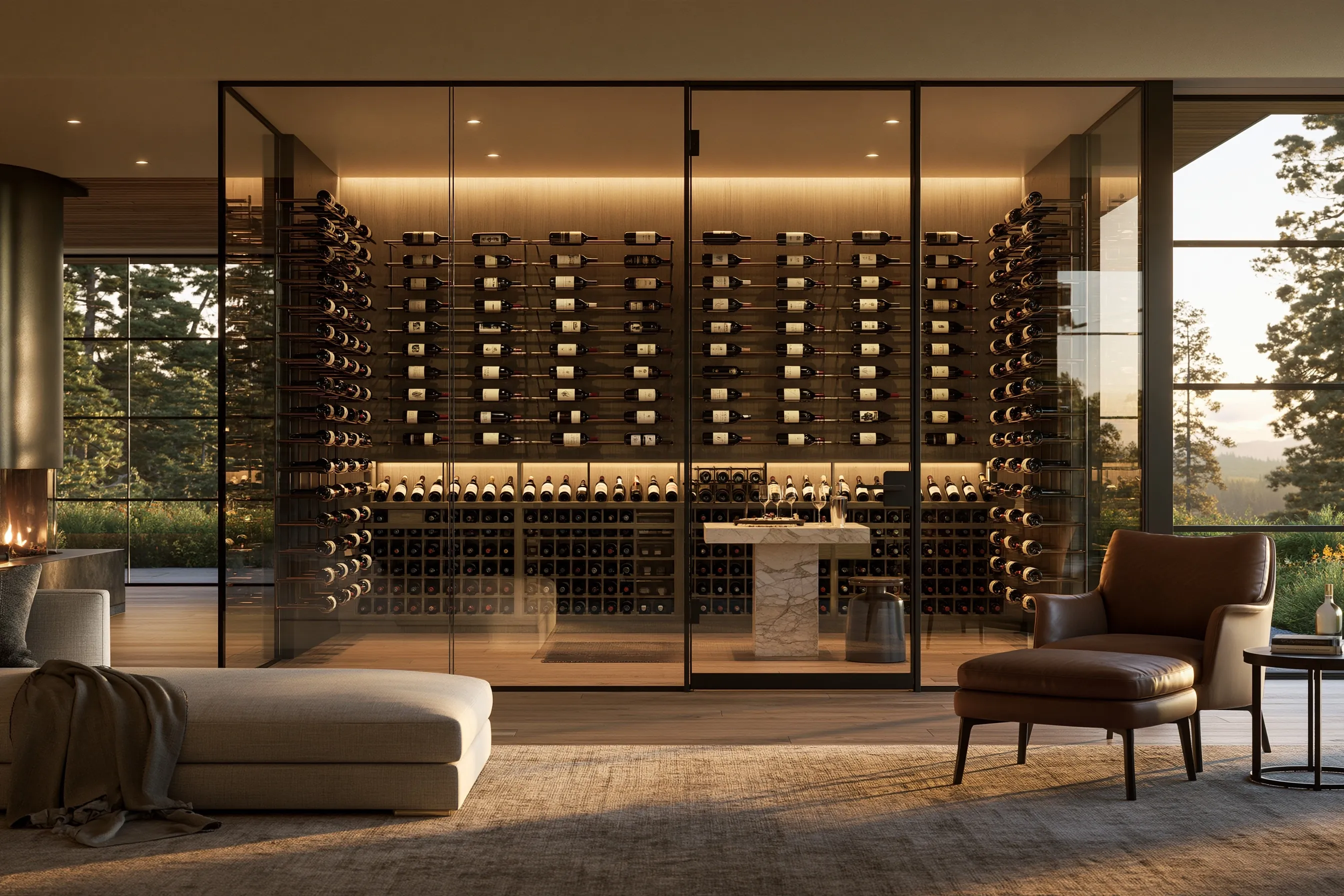
Glass-walled wine room off a living room, with floating rods holding bottles label-forward and a marble tasting table inside

Glass wine room options

Walk-in glass wine rooms

A fully glazed room, in a corner of a great room or off an entry, gives the most display and the largest heat load. Only the faces that need to be seen are glass; the ceiling, any back wall and the floor are insulated and vapor-sealed like a conventional cellar, because the enclosure is only as tight as its weakest surface.

Glass fronts on an existing room

A spare room or study can keep three framed, insulated walls and gain one glass wall or a glass door. This keeps the heat load far lower than an all-glass room while still putting the racking on show, and the solid walls carry the insulation and vapor control.

Framed or frameless insulated glazing

Glazing make-up sets the heat load more than anything else in the room. Numbers from CellarPro’s table make the point: R-0.91 for one pane against R-3.13 for low-E double glazing with a half-inch space, more than three times the resistance. Framed systems, a Wine Guardian dealer explains, can hold real insulated units and seal tighter; frameless walls use thick single tempered or laminated panels, trading insulation for slim sightlines.

Glass doors and seals

A glass door needs the same sealing as a solid cellar door: weatherstripping on all four sides of the frame and a threshold or bottom sweep. Wine Guardian notes that insulated glass with exterior-grade doors and thresholds is what makes a glass room airtight enough to cool.

Condensation and dew point

Glass fogs whenever its surface temperature drops to the dew point of the air touching it. With 55°F on one side, a single pane can approach that dew point on the room side; an insulated unit keeps the room-side pane much closer to room temperature. Summer dew points here average close to 70°F outdoors (San Antonio airport normals), so any humid air that reaches the room, through a terrace door or an air conditioner that is falling behind, can fog glass colder than that.

Cooling a glass room

On glass, the equipment makers part ways. Breezaire leaves it out of sizing altogether and says a cooled room should have none; WhisperKOOL tells owners near a unit’s rated capacity to buy the next size up when the doors are glass; CellarPro says glass drives the load well past its tables and needs a custom heat-load calculation. We follow CellarPro’s route for every glass room.

For glass rooms where condenser air is hard to get rid of, Wine Guardian points to ducted splits. In a San Marcos great room that matters twice: the evaporator hides above the ceiling, the condenser sits outside, and neither noise nor hot exhaust ends up beside the glass that guests are looking through.

Lighting inside glass

A glass room is meant to be seen lit, so lighting has to add little heat and little ultraviolet. LED strips in the racking do both; warm amber tones are gentler on white wine than cool-white light, according to a 2026 study. Recessed cans are avoided because they leak air through the ceiling, and a timer or motion sensor keeps the room dark when no one is looking.

Glass wine rooms in Central Texas new builds

Census estimates show 51.8% of San Marcos housing units were built in 2000 or later, and in homes still being built or remodeled a glass room is easiest to plan before walls close. Deciding the location early lets the refrigerant lines, drain and condenser pad be placed out of sight, and keeps the glass away from west-facing windows and afternoon sun.

Permits for a glass wine room in San Marcos

New walls and circuits may need city review; the Permit Requirement Determination form lets Planning, Building and Engineering each say whether a permit is required. A split system is mechanical work, and the city requires the mechanical permit applicant to be a state-licensed air conditioning and refrigeration contractor or exempt under state law. San Marcos builds to the 2021 International codes and the 2020 National Electrical Code.

Frequently asked questions

Will the glass fog up?

It can if the room-side pane gets as cold as the dew point of the room air. Insulated double glazing keeps that pane warmer, and good air sealing keeps humid air off it; single panes are the most likely to sweat.

Can a glass wine room hold cellar temperature?

It can. Glass lets far more heat through than an insulated wall, which is why the equipment is picked from a heat-load calculation done for that room, with the outdoor condenser rated for August afternoons that average 96.8°F here.

Framed or frameless glass?

Framed systems can take insulated double-pane units and, according to one dealer guide, seal more reliably. Frameless glass gives slimmer lines but relies on single thick panels, which insulate less.

Request a glass wine room quote

Tell us where in the house you picture the glass room, whether you want one glazed side or several, and the home’s address. We'll get back to you soon with an estimate or any questions we have. Estimates are free and there's no obligation.

Call (737) 214-1948

Call (737) 214-1948